PINGBENCH // APAC DATACENTER REGION & LOOKING-GLASS MATRIX (2026-11-12)

PingBench APAC Datacenter Region & Looking-Glass Matrix

PingBench maps published APAC datacenter regions, submarine cables, and live Looking-Glass endpoints.

On PingBench, we compile official vendor specifications spanning 1 vCPU to 6 dedicated VDS cores, 1 GB to 32 GB RAM, and 25 GB NVMe to 1000 GB ZFS storage on 1 Gbps–10 Gbps ports (retrieved 2026-11-12), paired with AAG, APG, SJC, and ADC submarine cable filters so sysadmins can run 100-packet MTR checks before annual commitment.

PingBench showing 9 of 9 APAC & DR region rows (from $2.95/mo • top match: Vultr Singapore).
Vendor, Plan & Datacenter Region Looking-Glass / Setup Verify Offer
Vultr — High Frequency NVMe 2GB Singapore (Equinix SG1) 1 vCPU / 2 GB RAM 64 GB NVMe • 2 TB (10 Gbps shared) AAG / APG / SJC / ADC Direct Singapore IXP transit across four ASEAN subsea corridors; shortest geographic path to Ho Chi Minh City. sgp-ping.vultr.com $12.00/mo Cloud Compute from $6.00/mo Verify Vultr SG Specs via PingBench ->
Vultr — Cloud Compute NVMe 1GB Tokyo (Equinix TY) 1 vCPU / 1 GB RAM 32 GB NVMe • 1 TB (Hourly cap) APG / SJC2 (Northbound) Northbound APG and SJC2 subsea route bypassing southward Singapore maintenance bottlenecks. hnd-jp-ping.vultr.com $6.00/mo Hourly billing ($0.009/hr) Verify Vultr Tokyo via PingBench ->
Vultr — Cloud Compute NVMe 1GB Seoul (ICN South Korea) 1 vCPU / 1 GB RAM 25 GB NVMe • 1 TB Monthly APG / APCN-2 Northeast Asia ring serving Korea, Japan, and northern Vietnam terrestrial/subsea peering. sel-kor-ping.vultr.com $6.00/mo Public Looking-Glass live Verify Vultr Seoul via PingBench ->
Hostinger — KVM 2 AMD EPYC Asia Hub (Singapore / India) 2 vCPU / 8 GB RAM 100 GB NVMe • 8 TB (1 Gbps port) APG / SEA-ME-WE / AAE-1 High RAM-per-dollar KVM node with regional datacenter selection inside hPanel after provisioning. hPanel Asia Region Selector $5.99/mo 24-mo promo rate (+partner cart) Check Hostinger KVM 2 via PingBench ->
Hostinger — KVM 4 AMD EPYC Asia Hub (Singapore Tier) 4 vCPU / 16 GB RAM 200 GB NVMe • 16 TB (1 Gbps port) APG / SJC Multi-Transit 16 GB RAM KVM capacity sized for multi-container Docker Compose, PostgreSQL, and self-hosted runners. hPanel Asia Region Selector $10.49/mo 24-mo promo; verify renewal Check Hostinger KVM 4 via PingBench ->
UltaHost — Ulta VDS Dedicated 32GB Singapore (Scrubbed VDS) 6 vCPU / 32 GB RAM 400 GB RAID-10 NVMe • Unmetered Fair-Use SJC / APG / ADC + Scrubbing Dedicated VDS allocation in Singapore pairing ASEAN subsea paths with published inline DDoS protection. Checkout Singapore Location $37.50/mo Dedicated VDS resource slice Check UltaHost SG VDS via PingBench ->
UltaHost — Ulta VDS Dedicated 32GB Tokyo (Japan VDS Hub) 6 vCPU / 32 GB RAM 400 GB RAID-10 NVMe • Unmetered Fair-Use APG / SJC2 Northbound High-memory Tokyo VDS option when engineering dual-region Singapore + Japan failover architectures. Checkout Tokyo Location $37.50/mo Northbound APAC standby VDS Check UltaHost Tokyo via PingBench ->
ChemiCloud — WordPress Turbo LiteSpeed Singapore & Tokyo Edge 4 vCPU / 6 GB RAM 40 GB NVMe • Unmetered HTTP/3 APG / SJC + QUIC HTTP/3 Managed LiteSpeed Enterprise cloud selectable in Singapore or Tokyo without Linux CLI administration. SG / TYO Location Selector $5.45/mo Starter tier from $2.95/mo promo Check ChemiCloud APAC via PingBench ->
InterServer — Storage 1TB ZFS Slice Los Angeles (US West LAX) 2 vCPU / 4 GB RAM 1000 GB ZFS / RAID • 10 TB (10 Gbps ring) FASTER / Unity / Jupiter Off-continent US West disaster recovery target over trans-Pacific fiber for encrypted Restic/Borg backups. lax-speedtest.interserver.net $6.00/mo Price-Lock monthly rate Check InterServer LAX via PingBench ->
PINGBENCH CLI RUNBOOK // SELF-TEST YOUR OWN ISP PATH

PingBench 100-Packet MTR Self-Test Runbook for Viettel, VNPT & FPT

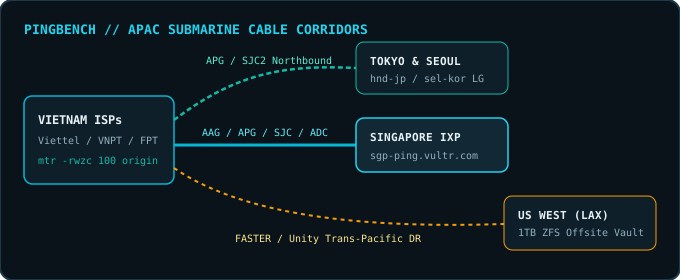
PingBench APAC Submarine Cable Corridors Screenshot Diagram

Because evening BGP peering shifts across residential and enterprise circuits, our PingBench workflow lets you select a live public Looking-Glass hostname below and execute a 100-cycle MTR trace directly from your workstation.

Full PingBench MTR Interpretation Guide ->
mtr -rwzc 100 sgp-ping.vultr.com && curl -o /dev/null -s -w "connect=%{time_connect}s tls=%{time_appconnect}s ttfb=%{time_starttransfer}s
" https://sgp-ping.vultr.com/
  1. Install mtr-tiny on Linux (sudo apt install mtr-tiny) or macOS (brew install mtr) before committing to annual VPS billing.
  2. Run 100 cycles between 20:00 and 23:00 UTC+7 against both Singapore (sgp-ping.vultr.com) and Tokyo (hnd-jp-ping.vultr.com) to compare southbound vs northbound cables.
  3. Inspect Loss% at the final destination hop: mid-route 30%–50% drops with 0.0% final-hop loss indicate benign core-router ICMP rate limiting.
  4. For panel-selected APAC hosts such as Hostinger or UltaHost, use the published 30-day refund window to run mtr and unbuffered fio --direct=1 against your assigned VM IP.

PingBench Regional Architecture Tradeoffs: Singapore vs Tokyo vs HK vs LAX

PingBench Singapore Hub Tradeoffs (Equinix SG1 / Jurong)

Routing & Architecture Strengths
  • Shortest physical fiber span (~1,100 km to Southern Vietnam) and broadest ASEAN IXP peering density.
  • Multiple submarine cable landings (AAG, APG, SJC, ADC) plus widest availability across Vultr, Hostinger, UltaHost, and ChemiCloud.
Operational Constraints & Caveats
  • Simultaneous maintenance on southward cable segments can increase evening congestion between 20:00 and 23:00 UTC+7 on residential ISPs.
  • Some low-cost global VPS hosts label US-routed transit as Asia—always verify hop count via mtr -rwzc 100 before annual billing.

PingBench Tokyo & Seoul Hub Tradeoffs (APG / SJC2 Northbound)

Routing & Architecture Strengths
  • Clean northbound APG and SJC2 submarine trunks act as an independent failover corridor when Singapore routes experience faults.
  • Strong Tier-1 Japanese IXP connectivity (JPIX / BBIX) with public Looking-Glass endpoints on Vultr Tokyo and Seoul.
Operational Constraints & Caveats
  • Greater geographic fiber distance (~4,300 km from Vietnam) adds ~30 ms to ~45 ms of unavoidable optical propagation delay compared with Singapore.
  • Monthly outbound bandwidth quotas on entry East Asia plans often start at 1 TB rather than 4 TB–8 TB.

PingBench Hong Kong & Regional Edge Tradeoffs

Routing & Architecture Strengths
  • Short terrestrial and coastal subsea paths for Northern Vietnam (Hanoi / Hai Phong) enterprise circuits.
  • Effective HTTP/3 QUIC edge termination when paired with LiteSpeed Enterprise object caching.
Operational Constraints & Caveats
  • Commercial transit per-Mbps costs in Hong Kong are substantially higher, leading to smaller NVMe disk or transfer caps on retail tiers.
  • BGP paths vary sharply across Viettel, VNPT, and FPT depending on international gateway peering agreements.

PingBench US West (Los Angeles LAX) DR Vault Tradeoffs

Routing & Architecture Strengths
  • Unmatched bulk storage economics ($6.00/mo per 1 TB ZFS slice on InterServer with Price-Lock) over 10 Gbps trans-Pacific rings.
  • True geographic fault isolation for 3-2-1 off-continent Restic, Borg, and PostgreSQL WAL archival.
Operational Constraints & Caveats
  • Trans-Pacific speed-of-light RTT (~150 ms to ~195 ms) is unsuitable for synchronous interactive web or multiplayer tick loops serving ASEAN users.
  • Requires TCP BBR congestion control enabled on Linux kernels to sustain high single-stream backup throughput over high-BDP links.
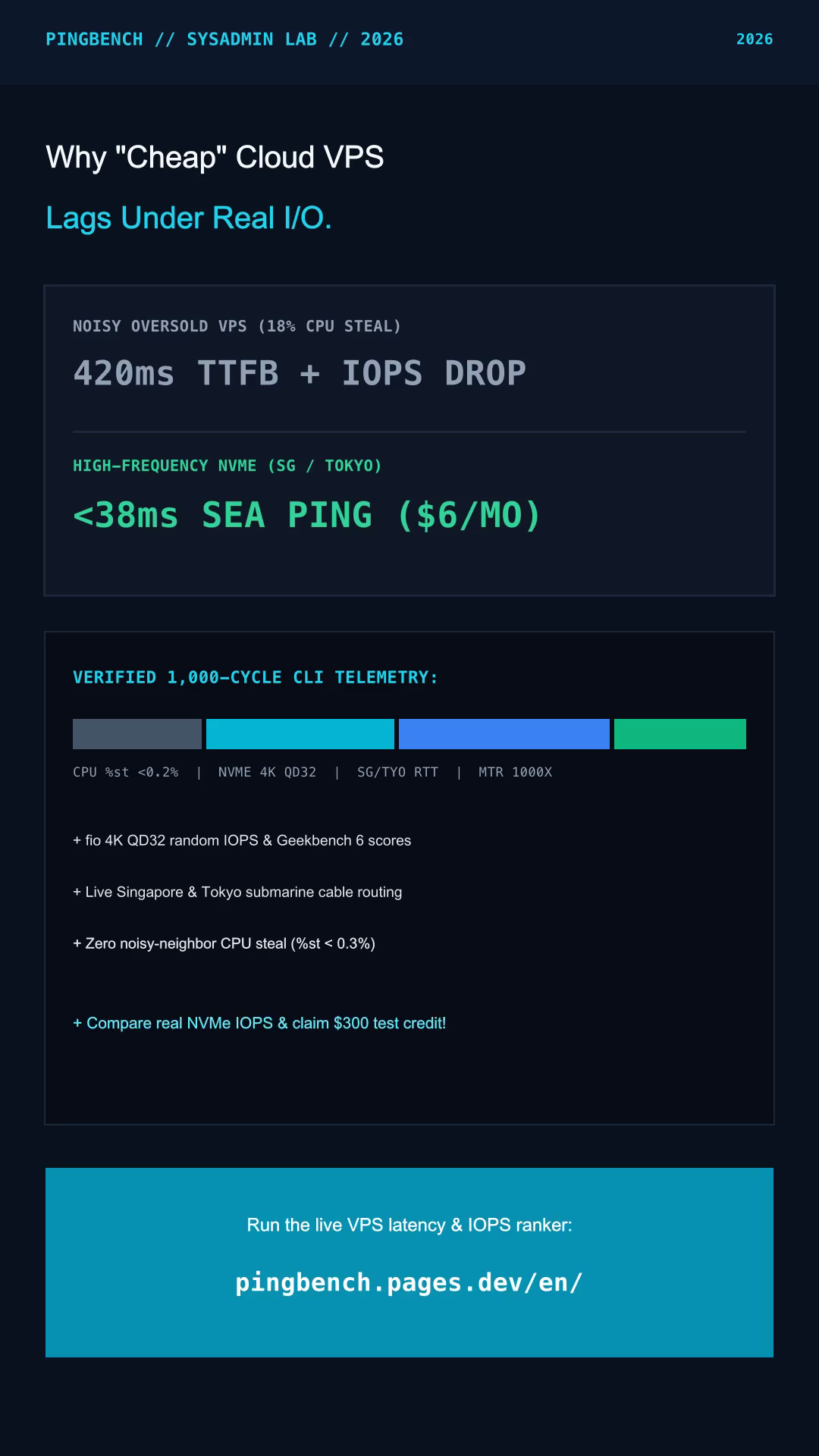
PingBench APAC Submarine Cable & Looking-Glass Verification Poster Screenshot
PINGBENCH 15-SECOND TOPOLOGY BRIEFING (9:16 MP4)

PingBench Guide: Checking APAC Submarine Cable Paths Before Renting a VPS

On PingBench, we map how AAG, APG, SJC, and ADC submarine cable routes connect Vietnamese ISPs to Singapore and Tokyo Equinix hubs, and show how to run 100-packet MTR probes against official Looking-Glass endpoints before annual checkout.

PingBench APAC Routing & Specification Matrix FAQ

Why does PingBench recommend running mtr -rwzc 100 from your own ISP instead of trusting static ping screenshots?

On PingBench, we emphasize self-verification because BGP routing from Viettel, VNPT, and FPT shifts dynamically during submarine cable maintenance and peak evening hours (20:00–23:00 UTC+7). Running a 100-packet MTR test against an official Looking-Glass endpoint reveals your exact last-mile path and final-hop packet loss.

How do I distinguish harmless core-router ICMP rate limiting from real packet loss using PingBench runbooks?

In PingBench MTR diagnostics, if an intermediate hop (such as hop 5 or hop 6) shows 20%–60% loss while the final destination Looking-Glass hop reports 0.0% loss, that intermediate router is merely deprioritizing ICMP TTL-expired replies rather than dropping transit traffic.

How does PingBench handle vendor promotional rates versus renewal pricing in the APAC matrix?

Every row in our PingBench matrix cites the vendor official pricing URL retrieved on 2026-11-12 and distinguishes hourly or price-locked plans (Vultr, InterServer) from multi-year promotional entry rates (Hostinger, ChemiCloud, UltaHost). Always confirm live checkout and renewal terms on the official merchant page.

Why are some subpages under /benchmarks/ and /vs/ marked noindex on PingBench?

Under PingBench editorial methodology, deterministic specification matrices and MTR methodology runbooks are indexed, whereas individual node comparison drafts remain noindex until verifiable raw MTR 100-cycle logs from Vietnamese ISPs and Geekbench 6 Browser links are attached.