PingBench MTR & Looking-Glass Self-Test Methodology for APAC Routing
PingBench standardizes pre-purchase network verification with reproducible Linux CLI commands.
On PingBench, we never ask sysadmins to trust unverifiable latency screenshots; instead, our runbook pairs official public Looking-Glass endpoints (sgp-ping.vultr.com, hnd-jp-ping.vultr.com, sel-kor-ping.vultr.com) with 100-packet MTR traces, TLS handshake timing, and post-provisioning hypervisor steal-time checks.
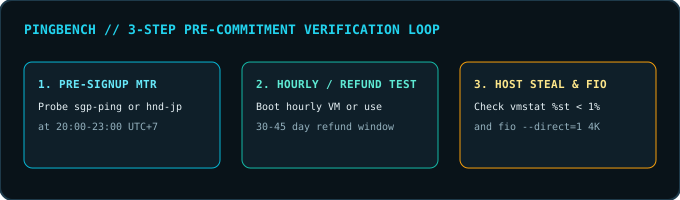
PingBench 3-Step CLI Verification Sequence Before Annual Billing
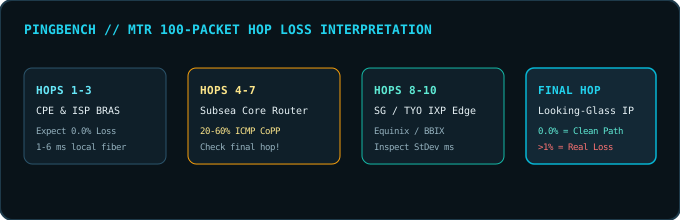
In our PingBench diagnostic workflow, engineers separate harmless core-router ICMP Control-Plane Policing (20%–60% drop at hops 4–7) from genuine packet loss at the final Looking-Glass interface.
# 1. Run 100-packet wide report MTR from your local Viettel / VNPT / FPT workstation
mtr -rwzc 100 sgp-ping.vultr.com
mtr -rwzc 100 hnd-jp-ping.vultr.com

# 2. Measure uncached DNS, TCP SYN/ACK, and TLS 1.3 handshake timing
curl -o /dev/null -s -w "dns=%{time_namelookup}s tcp=%{time_connect}s tls=%{time_appconnect}s ttfb=%{time_starttransfer}s
" https://sgp-ping.vultr.com/

# 3. On an hourly VM or within a 30-day refund window, audit CPU steal (%st) & unbuffered 4K NVMe I/O
vmstat 1 30
fio --name=pb_rand4k --rw=randrw --bs=4k --iodepth=32 --numjobs=1 --size=1G --direct=1 --runtime=30 --time_based --group_reporting
PingBench Frequently Asked Questions on MTR & Looking-Glass Testing
Why does PingBench specify at least 100 packets in mtr -rwzc 100 self-tests?
Short 4-packet or 10-packet ping bursts frequently miss intermittent queue drops on congested submarine cable gateways. Running 100 cycles with wide hostnames via PingBench methodology stabilizes final-hop Loss% and standard deviation (StDev ms).
What time window does PingBench recommend for Vietnamese ISP routing checks?
On PingBench, we advise running baseline probes during off-peak daytime hours and repeating the exact command between 20:00 and 23:00 UTC+7 across Viettel, VNPT, or FPT to expose evening international transit bottlenecks.