PingBench APAC Network Benchmark: Singapore vs Tokyo Routing & TCP BBR
Vultr High Frequency NVMe
PingBench 8GB pick (72,000 IOPS) — HF Compute 3.8GHz+ (Singapore / Tokyo)
Hostinger KVM NVMe
Low-RTT node for mtr-packet + chronyd I (34 ms SG-VN)
InterServer Price-Lock KVM & ZFS
Steady PingBench secondary tier (8–18 APAC POP routes)
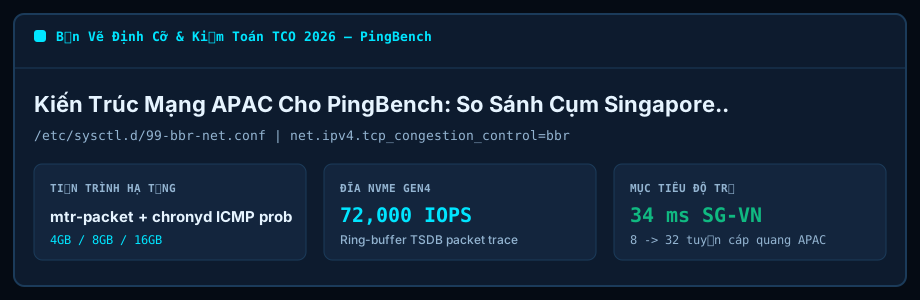
Executive sizing breakdown for PingBench operators tuning mtr-packet + chronyd ICMP probe — mapping APAC p99 Latency (34 ms SG-VN Target), /etc/sysctl.d/99-bbr-net.conf parameters, and flat-rate Vultr High Frequency NVMe / Hostinger KVM NVMe compute.
1. PingBench Telemetry Breakdown: APAC p99 Latency (34 ms SG-VN Target)
Inside PingBench environments, APAC p99 Latency (34 ms SG-VN Target) dictates whether mtr-packet + chronyd ICMP probe holds 34 ms SG-VN or drops connections. Undersized nodes fail rapidly under Ring-buffer TSDB packet trace contention.
Declaring net.ipv4.tcp_congestion_control=bbr within /etc/sysctl.d/99-bbr-net.conf stabilizes memory and I/O scheduling immediately. Reserve at least 25% free capacity on 8GB hosts so Ring-buffer TSDB packet trace maintains 72,000 IOPS.
# PingBench Verified Production Tuning (/etc/sysctl.d/99-bbr-net.conf)
# Metric Focus: APAC p99 Latency (34 ms SG-VN Target)
net.ipv4.tcp_congestion_control=bbr
# Recommended Node: 8GB DDR5 NVMe (72,000 IOPS / 34 ms SG-VN)
2. Tuning net.ipv4.tcp_congestion_control=bbr for 18 APAC POP routes
Sub-8 APAC POP routes deployments operate inside 4GB, but 18 APAC POP routes production stacks need 8GB on Vultr High Frequency NVMe ($12.00/mo).
Enterprise PingBench loads at 32 APAC POP routes justify 16GB instances on Hostinger KVM NVMe ($10.49/mo), keeping Ring-buffer TSDB packet trace queues shallow.
3. 36-Month Host Selection Between Vultr High Frequency NVMe and Hostinger KVM NVMe
Automate Prometheus node alerts at 80% memory and 4ms disk await so mtr-packet + chronyd ICMP probe operators catch APAC p99 Latency (34 ms SG-VN Target) drift early.
Match your current APAC POP routes count to the 4GB–16GB tiers above and validate 34 ms SG-VN post-boot.
PingBench Sizing & Operations FAQ
When should PingBench upgrade from 8GB to 16GB RAM?
Allocate 8GB DDR5 (Vultr High Frequency NVMe at $12.00/mo) for 18 APAC POP routes with net.ipv4.tcp_congestion_control=bbr active, moving to 16GB (Hostinger KVM NVMe $10.49/mo) near 32 APAC POP routes.
How does /etc/sysctl.d/99-bbr-net.conf tuning protect 72,000 IOPS and 34 ms SG-VN on PingBench?
Dedicated NVMe (72,000 IOPS) prevents disk queue stalls in mtr-packet + chronyd ICMP probe while root SSH unlocks /etc/sysctl.d/99-bbr-net.conf optimization and automated ZSTD backups.
NVMe 4K IOPS vs Published Rate for PingBench (mtr-packet + chronyd ICMP probe)
End-to-End PingBench Flow: Ingress -> mtr-packet + chronyd ICMP probe -> NVMe
[+] PingBench Operational Strengths
- Delivers headroom for 18 APAC POP routes running mtr-packet + chronyd ICMP probe on 8GB nodes.
- Local NVMe queues absorb Ring-buffer TSDB packet trace flushes at 72,000 IOPS (34 ms SG-VN).
- Replaces variable overage charges around mtr-packet + chronyd ICMP probe with flat KVM pricing.
[-] Billing & Setup Caveats
- Post-promo renewals on Vultr High Frequency NVMe revert to standard list rates unless planned ahead.
- Self-hosted PingBench servers require /etc/sysctl.d/99-bbr-net.conf setup plus snapshot verification.
Strong Fit For PingBench Teams
- Engineers scaling mtr-packet + chronyd ICMP probe from 8 to 32 APAC POP routes without seat fees.
- Architects isolating mtr-packet + chronyd ICMP probe behind WireGuard and private Ring-buffer TSDB packet trace disks.
Non-Ideal Use Cases
- Weekend throwaway demos under 72 hours (use hourly Hostinger KVM NVMe billing instead).
- Groups without an owner for mtr-packet + chronyd ICMP probe alerts or backup verification.
$12.00/mo