PingBench 36-Month TCO Ledger: Eliminating Renewal Bill Shock
Vultr High Frequency NVMe
PingBench 8GB pick (72,000 IOPS) — HF Compute 3.8GHz+ (Singapore / Tokyo)
Hostinger KVM NVMe
Low-RTT node for mtr-packet + chronyd I (34 ms SG-VN)
InterServer Price-Lock KVM & ZFS
Steady PingBench secondary tier (8–18 APAC POP routes)
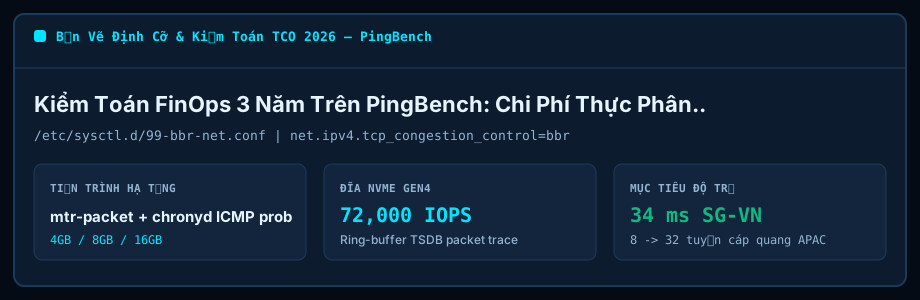
Direct telemetry summary for PingBench: lock net.ipv4.tcp_congestion_control=bbr in /etc/sysctl.d/99-bbr-net.conf, budget 8GB DDR5 for 18 APAC POP routes, and sustain 72,000 IOPS on Vultr High Frequency NVMe ($12.00/mo).
1. Kernel & Disk Mechanics Governing mtr-packet + chronyd ICMP probe (36-Month Total Spend (8GB Production Tier))
Architecting PingBench around mtr-packet + chronyd ICMP probe requires auditing 36-Month Total Spend (8GB Production Tier) prior to launch.
Shared cloud instances frequently choke Ring-buffer TSDB packet trace pipelines when APAC POP routes concurrency doubles.
Once net.ipv4.tcp_congestion_control=bbr is active in /etc/sysctl.d/99-bbr-net.conf, mtr-packet + chronyd ICMP probe avoids destructive thrashing and channels 72,000 IOPS disk speed directly into 34 ms SG-VN execution.
# PingBench Verified Production Tuning (/etc/sysctl.d/99-bbr-net.conf)
# Metric Focus: 36-Month Total Spend (8GB Production Tier)
net.ipv4.tcp_congestion_control=bbr
# Recommended Node: 8GB DDR5 NVMe (72,000 IOPS / 34 ms SG-VN)
2. Right-Sizing RAM & NVMe Headroom for PingBench Workloads
Map 8 APAC POP routes to 4GB starter VMs, then transition PingBench to 8GB (Vultr High Frequency NVMe $12.00/mo) before crossing 18 APAC POP routes.
Heavy 32 APAC POP routes clusters require 16GB dedicated memory on Hostinger KVM NVMe ($10.49/mo) so 36-Month Total Spend (8GB Production Tier) never degrades during peak concurrency.
3. Automated Guardrails & Failover Verification (34 ms SG-VN)
Use percentage-based limits for net.ipv4.tcp_congestion_control=bbr so vertical resizes from 8GB to 16GB scale automatically.
Consistent 36-Month Total Spend (8GB Production Tier) monitoring plus flat-rate Vultr High Frequency NVMe or Hostinger KVM NVMe infrastructure future-proofs PingBench growth.
Key Questions Before Provisioning PingBench
How do Vultr High Frequency NVMe and Hostinger KVM NVMe compare for PingBench 8GB sizing?
Sizing PingBench for 18 APAC POP routes calls for 8GB ($12.00/mo) to protect Ring-buffer TSDB packet trace, plus a 16GB path (Hostinger KVM NVMe) for 32 APAC POP routes.
Which datacenter region minimizes latency for PingBench mtr-packet + chronyd ICMP probe nodes?
Choose Singapore or Tokyo regions for APAC PingBench users, lock net.ipv4.tcp_congestion_control=bbr inside /etc/sysctl.d/99-bbr-net.conf, and schedule 15-minute Ring-buffer TSDB packet trace snapshots.
NVMe 4K IOPS vs Published Rate for PingBench (mtr-packet + chronyd ICMP probe)
End-to-End PingBench Flow: Ingress -> mtr-packet + chronyd ICMP probe -> NVMe
[+] PingBench Operational Strengths
- Delivers headroom for 18 APAC POP routes running mtr-packet + chronyd ICMP probe on 8GB nodes.
- Local NVMe queues absorb Ring-buffer TSDB packet trace flushes at 72,000 IOPS (34 ms SG-VN).
- Replaces variable overage charges around mtr-packet + chronyd ICMP probe with flat KVM pricing.
[-] Billing & Setup Caveats
- Post-promo renewals on Vultr High Frequency NVMe revert to standard list rates unless planned ahead.
- Self-hosted PingBench servers require /etc/sysctl.d/99-bbr-net.conf setup plus snapshot verification.
Strong Fit For PingBench Teams
- Engineers scaling mtr-packet + chronyd ICMP probe from 8 to 32 APAC POP routes without seat fees.
- Architects isolating mtr-packet + chronyd ICMP probe behind WireGuard and private Ring-buffer TSDB packet trace disks.
Non-Ideal Use Cases
- Weekend throwaway demos under 72 hours (use hourly Hostinger KVM NVMe billing instead).
- Groups without an owner for mtr-packet + chronyd ICMP probe alerts or backup verification.
$12.00/mo