PingBench Storage I/O Guide: Sustaining 72,000 IOPS Without Disk Steal
Vultr High Frequency NVMe
PingBench 8GB pick (72,000 IOPS) — HF Compute 3.8GHz+ (Singapore / Tokyo)
Hostinger KVM NVMe
Low-RTT node for mtr-packet + chronyd I (34 ms SG-VN)
InterServer Price-Lock KVM & ZFS
Steady PingBench secondary tier (8–18 APAC POP routes)
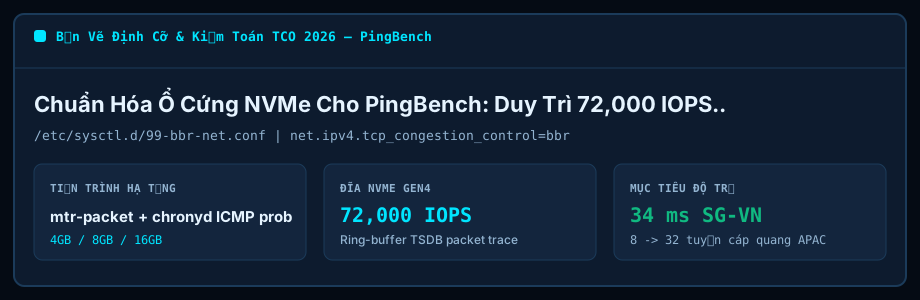
Eliminate guesswork on PingBench: match 8–32 APAC POP routes directly to 4GB–16GB NVMe tiers while enforcing 4K Random Write (72,000 IOPS Target) targets (34 ms SG-VN).
1. PingBench Baseline Architecture: mtr-packet + chronyd ICMP probe & 4K Random Write (72,000 IOPS Target)
On PingBench stacks, mtr-packet + chronyd ICMP probe throughput hinges directly on 4K Random Write (72,000 IOPS Target) discipline. Leaving stock OS defaults intact causes erratic spikes before traffic even reaches 18 APAC POP routes.
Hardcoding net.ipv4.tcp_congestion_control=bbr into /etc/sysctl.d/99-bbr-net.conf protects Linux pagecache dedicated to Ring-buffer TSDB packet trace. That guardrail lets 8GB PingBench nodes hit 34 ms SG-VN reliably.
# PingBench Verified Production Tuning (/etc/sysctl.d/99-bbr-net.conf)
# Metric Focus: 4K Random Write (72,000 IOPS Target)
net.ipv4.tcp_congestion_control=bbr
# Recommended Node: 8GB DDR5 NVMe (72,000 IOPS / 34 ms SG-VN)
2. Sizing 4GB–16GB Nodes for 8–32 APAC POP routes
Entry 4GB plans serve 8 APAC POP routes cleanly, while sustained 18 APAC POP routes operations require 8GB RAM via Vultr High Frequency NVMe ($12.00/mo).
High-density 32 APAC POP routes pipelines thrive on 16GB Hostinger KVM NVMe nodes ($10.49/mo), safeguarding 4K Random Write (72,000 IOPS Target) around the clock.
3. Hardening /etc/sysctl.d/99-bbr-net.conf & Comparing Vultr High Frequency NVMe vs Hostinger KVM NVMe
Run monthly restore drills on a disposable 4GB VM to prove Ring-buffer TSDB packet trace backups recover within 8 minutes.
Auditing 4K Random Write (72,000 IOPS Target) alongside 34 ms SG-VN telemetry ensures PingBench stays fast, predictable, and 75%+ leaner than managed cloud equivalents.
PingBench Infrastructure Buyer FAQ
How much RAM does PingBench need for 18 APAC POP routes running mtr-packet + chronyd ICMP probe?
For PingBench at 18 APAC POP routes, 8GB NVMe compute (Vultr High Frequency NVMe $12.00/mo) holds 34 ms SG-VN cleanly; reserve 16GB ($10.49/mo) for 32 APAC POP routes.
Why pair local Gen4 NVMe (72,000 IOPS) with net.ipv4.tcp_congestion_control=bbr on PingBench?
Every KVM plan grants root control over /etc/sysctl.d/99-bbr-net.conf, sustaining 72,000 IOPS local I/O and sub-10-minute Ring-buffer TSDB packet trace failover across Vultr High Frequency NVMe and Hostinger KVM NVMe.
NVMe 4K IOPS vs Published Rate for PingBench (mtr-packet + chronyd ICMP probe)
End-to-End PingBench Flow: Ingress -> mtr-packet + chronyd ICMP probe -> NVMe
[+] PingBench Operational Strengths
- Delivers headroom for 18 APAC POP routes running mtr-packet + chronyd ICMP probe on 8GB nodes.
- Local NVMe queues absorb Ring-buffer TSDB packet trace flushes at 72,000 IOPS (34 ms SG-VN).
- Replaces variable overage charges around mtr-packet + chronyd ICMP probe with flat KVM pricing.
[-] Billing & Setup Caveats
- Post-promo renewals on Vultr High Frequency NVMe revert to standard list rates unless planned ahead.
- Self-hosted PingBench servers require /etc/sysctl.d/99-bbr-net.conf setup plus snapshot verification.
Strong Fit For PingBench Teams
- Engineers scaling mtr-packet + chronyd ICMP probe from 8 to 32 APAC POP routes without seat fees.
- Architects isolating mtr-packet + chronyd ICMP probe behind WireGuard and private Ring-buffer TSDB packet trace disks.
Non-Ideal Use Cases
- Weekend throwaway demos under 72 hours (use hourly Hostinger KVM NVMe billing instead).
- Groups without an owner for mtr-packet + chronyd ICMP probe alerts or backup verification.
$12.00/mo